RoboForex – Professional services on Forex market

Trading Robots and Expert Advisors for MetaTrader 4 and MetaTrader 5

VR Trade Panel - Professional Trading Panel

Icon version of the program Version: 25.070

Icon program update date Updated: 10.07.2025

Icon date of adding the program Added: 17.11.2014

License: Shareware

One-time purchase: 0$
Rent: from 0$

VR Trade Panel is a professional solution for trading, which allows you to effectively manage positions using trend lines. Unique functionality allows you to install Stop Loss and Take Profit both at dynamic levels (inclined lines) and fixed values.

VR Lollipop – trend collecting trading robot

Icon version of the program Version: 25.071

Icon program update date Updated: 28.07.2025

Icon date of adding the program Added: 28.10.2022

License: Paid-Free

One-time purchase:
189$79$
Rent:
from 30$from 15$

The VR Lollipop trading robot is an automated trading strategy designed to operate on trend movements of various financial instruments. Its main goal is the accumulation of profitable positions.
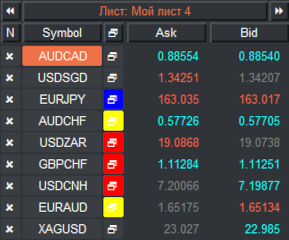
VR Watch list and Linker – Screener for MetaTrader

Icon version of the program Version: 25.070

Icon program update date Updated: 27.07.2025

Icon date of adding the program Added: 01.07.2015

License: Paid-Free

One-time purchase:
98$48$
Rent:
from 30$from 28$

Financial instruments screener for manual search and selection of the most interesting and liquid financial instruments. Designed for MetaTrader 4 and MetaTrader 5 terminals. The best solution for trading stocks.

VR Smart Grid - Smart Trading Robot

Icon version of the program Version: 25.110

Icon program update date Updated: 01.11.2025

Icon date of adding the program Added: 27.03.2018

License: Paid-Free

One-time purchase:
169$79$
Rent:
from 30$from 21$

VR Smart Grid is a smart trading adviser capable of closing a large number of market positions with a small profit. Closing in small parts allows you to quickly and effectively reduce unprofitable positions.

VR Black Box – modified “Swing” trading strategy

Icon version of the program Version: 24.121

Icon program update date Updated: 13.12.2024

Icon date of adding the program Added: 22.08.2017

License: Paid-Free

One-time purchase:
122$85$
Rent:
from 30$from 21$

VR Black Box is a powerful trading system built on the principle of following price movements. The trading robot has access to the functions of setting both real and virtual Take Profit and Stop Loss levels. The main objective of the algorithm is to maximize profits and minimize risks.

The VR Black Box system uses a combination of real and virtual stop loss and take profit levels, with the real levels hiding the virtual ones. The development of this strategy began in 2009, and over a period of more than ten years it has undergone many improvements and revisions. The principle of operation is reminiscent of the “Swing” strategy, when a purchase error is compensated by entering a sale. A special feature of the system is the presence of protective mechanisms to prevent getting into high-risk situations.

VR Locker - successful lock trading

Icon version of the program Version: 22.040

Icon program update date Updated: 11.04.2022

Icon date of adding the program Added: 30.08.2017

License: Paid-Free

One-time purchase:
122$69$
Rent:
from 30$from 21$

The program trades according to a unique logic, the task of which is not just to fix the profit, but also to use the accumulated profit as a safety cushion, which significantly reduces the drawdown on the balance.

VR Close All - Close all orders if ...

Icon version of the program Version: 17.100

Icon program update date Updated: 12.08.2015

Icon date of adding the program Added: 04.08.2015

License: Free

One-time purchase: 0$
Rent: from 0$

Designed for closing/deleting all orders in the terminal. It helps to fix profit or loss on the entire trading account.

VR Stealth Pro - an adviser invisible to the broker

Icon version of the program Version: 16.120

Icon program update date Updated: 13.12.2016

Icon date of adding the program Added: 10.09.2014

License: Free

One-time purchase: 0$
Rent: from 0$

The expert Advisor's interface is intuitive and easy. The EA hides the take Profit, Stop Loss, Breakeven, and Trailing Stop trading levels.

Answers to frequently asked questions

What is a trading robot?

Essentially, a trading robot is an algorithm written in a programming language integrated into a trading terminal (for example, MQL4 or MQL5 for MetaTrader). The robot’s operation is based on certain rules: when to open a trade, when to close it, the trade volume to enter the market with, and how to manage risks. All of these are set at the development and configuration stages.

Advisors can be used to trade various financial instruments: currency pairs in the Forex market, stocks, bonds, indices, commodities, and even cryptocurrencies. The versatility of algorithms allows a trader to select the most suitable instruments for their strategy and scale trading across different markets.

Advantages of trading robots

  • Elimination of the human factor and emotional influence.
  • Round-the-clock operation without breaks or days off.
  • High speed of information processing and decision-making.
  • Strict discipline and adherence to strategy.

Who are trading robots suitable for?

Trading robots can be used by both professional traders and beginners. For novices, robots provide an excellent opportunity to immerse themselves in the trading process without excessive burden. They allow trading with minimal human involvement while the trader learns and gains experience.

For professionals, having a robot is a way to scale trading. A trader can use multiple strategies simultaneously by running them via different algorithms, which helps diversify risks and increase potential profitability.

Risks and limitations

Despite obvious advantages, it is important to understand that a trading robot is just a tool. It is not a guarantee of profit and cannot ensure 100% success. The algorithm operates within the conditions set by the programmer or trader. If the strategy is initially constructed incorrectly or becomes outdated over time, the robot will trade at a loss.

It should also be remembered that financial markets are subject to unexpected events: economic crises, political decisions, natural disasters. In such situations, the automated system may fail because it relies solely on data analysis and cannot account for non-standard circumstances outside the algorithm.

Another concern is technical failures. The robot runs on a server or computer, and in cases of power outages, platform freezes, or internet connection issues, problems may arise with trade execution. Therefore, using VPS servers and reliable software becomes a necessary element of safe automation.

How to choose a trading robot

There are many ready-made solutions that can be bought or downloaded for free. However, when choosing an advisor, it is important to assess its reliability and effectiveness. Usually, robot validation is done through several methods:

  • Backtesting on historical data. This allows seeing how the algorithm performed in the past under various market conditions.
  • Demo account. Before using real money, it is always advisable to test the robot on a training account.
  • Real account monitoring. This is the final stage when the robot operates with minimal funds while the trader assesses its stability.

It is necessary to consider that the market is constantly changing, so algorithms require regular optimization and adjustment. Even the best robot can lose effectiveness over time if its parameters are not adapted to new conditions.

Impact on trading development

The emergence of trading robots has significantly changed the culture of trading itself. Whereas the entire process used to rely exclusively on manual analysis and the trader’s personal experience, today some functions are increasingly delegated to algorithms. The global trend is moving toward active automation and algorithmic strategies.

Large investment funds and banks have long used trading algorithms. Their programs perform millions of trades per second, providing liquidity in global markets. Such opportunities are unavailable to private traders, but even simple advisors greatly simplify work and make the process more systematic.

Conclusion

Trading robots are tools of modern trading that help automate the process of making trades, reduce the influence of the human factor, and maximize use of market opportunities. They suit beginners just starting in the market and experienced traders aiming to scale their strategies.

However, it is important to remember that a robot is not a source of guaranteed profit but merely an auxiliary tool. For successful operation, it must be combined with personal knowledge, strategic thinking, and continuous monitoring. Only then does automation become a reliable assistant and not a source of disappointment.

With an understanding of how trading robots work, a trader can effectively integrate them into their trading processes, use the strengths of automation, and minimize its weaknesses. Ultimately, it is the knowledgeable combination of human experience and algorithmic capabilities that paves the way to stable and effective trading.

What are trading robots for?

Trading robots are modern tools in a trader’s arsenal designed to automate processes on the financial markets. Their main goal is to relieve a person of part of the routine and technical workload, allowing them to focus on strategy, analysis, and making high-level decisions. By using trading robots, a trader gains an assistant capable of working around the clock, strictly following an algorithm and eliminating emotional factors that often affect trading results.

What are trading robots for?

The primary task of trading robots is to automate trading. A human cannot constantly stay at the monitor watching every market movement. Robots can analyze quotes around the clock, process indicator signals, and open or close trades in fractions of a second. This approach greatly increases efficiency and allows taking advantage of opportunities that arise not only during active European and US trading sessions but also at night or early morning.

Trading robots are especially useful for performing repetitive tasks such as setting stop-losses, take-profits, or entering the market on certain signals. For a trader, these tasks can be tiresome, especially if they must be done dozens or hundreds of times a day. Automation eliminates this routine and makes the trading process more systematic.

Use across various markets

Modern trading robots are versatile and can be applied to trade different assets. Most often they are used in currency markets (Forex), where 24/7 trading and high liquidity make automation especially effective. However, they are also in demand on stock markets for trading stocks, bonds, and more recently on cryptocurrency markets.

Some robots are developed for specific markets or strategies — for example, scalping, arbitrage, or long-term trading with position holding. Thanks to this, a trader can select a solution tailored exactly to their needs.

Advantages of trading robots

  • Emotion-free operation. The robot is not subject to fear or greed. Its behavior always strictly follows the algorithm.
  • 24/7 control. Markets operate 24/7, and even during sleep, a trader can be sure the algorithm will perform necessary actions.
  • Speed of information processing. The robot can analyze multiple instruments and indicators instantly.
  • Time saving. Automation frees the trader from constant monitoring.
  • Risk management. Many advisors include built-in risk controls and capital protection mechanisms.
  • Discipline assurance. The robot always follows the set logic without breaking rules.

Who benefits?

Trading robots can be indispensable both for professionals and beginners.

  • For beginners, they help reduce the workload, avoid mistakes due to inexperience, and learn by analyzing the algorithm’s work.
  • For experienced traders, robots are necessary to scale trading. Using multiple systems allows diversification of risks and operating several strategies simultaneously.

Profit opportunities

Automation provides a real chance to increase trading profitability. Robots catch even small price movements that are almost impossible to track manually. Moreover, they allow trading across several markets simultaneously, increasing the number of potentially profitable setups.

Additionally, trading robots are used for risk hedging — for example, when one position is insured by another automatically opened in the opposite direction. This approach reduces capital load during volatile periods.

However, it is important to understand that the profitability of a robot directly depends on the quality of its underlying strategy. The algorithm does not “think” independently; it simply follows the logic programmed by the developer or trader.

Limitations and risks

Despite clear advantages, trading robots have their limitations:

  • They do not guarantee success. Even the best algorithm can become unprofitable when market conditions change.
  • They are vulnerable to technical failures (internet outages, power loss, server errors).
  • They require regular monitoring and optimization.
  • Robots do not consider fundamental factors such as political events or economic crises.

Effective use of robots

  • Test algorithms on historical data and demo accounts.
  • Start trading with minimal volumes.
  • Regularly analyze statistics and optimize the system.
  • Adapt robot parameters to new market conditions.

Conclusion

Trading robots have become a key innovation in the trading world. Their purpose is to facilitate traders' work, improve trading efficiency, and reduce the influence of human factors. They provide round-the-clock market monitoring, disciplined strategy execution, and time savings.

However, one should not expect miracles. Robots are only tools, and success depends on the trader’s ability to use them wisely. It is a combination of intellectual approach, personal experience, and automation that leads to stable results and reliable strategies.

Thus, trading robots are meant to make trading more convenient, systematic, and efficient. But their power is unleashed only in the hands of an attentive and well-prepared trader.

What are the advantages of trading with robots?

Trading using automated systems, or so-called trading robots, has gained incredible popularity among traders in recent years. These programs represent a natural stage in the evolution of financial markets and their integration with modern technology. Where traders once manually analyzed charts, looked for entry and exit signals, and executed trades themselves, today much of this work can be delegated to an algorithm. Trading robots operate strictly according to set rules, are immune to emotions, and can work around the clock. To understand the true value of automation, it is necessary to examine the specific advantages that trading with robots offers.

Automation of routine tasks

One of the main advantages is automating repetitive actions. In practice, a trader must perform many identical steps daily: analyze quotes, open trades on certain signals, set stop losses and take profits, manage open positions. All this requires maximum concentration and consumes a lot of time.

The robot fully takes over these duties. It quickly reacts to market conditions, automatically opens and closes orders, and controls risk levels. This allows the trader to focus on strategy development and analysis rather than mechanical tasks.

Emotion-free operation

The human factor is one of the main causes of losses. Experienced traders may succumb to emotions like fear of losing money or greed, trying to hold profitable positions too long. This disrupts discipline and leads to underperformance of strategies.

The trading robot is emotionless. It does not experience fear, doubt, or euphoria. Its actions are limited to the programmed algorithm, ensuring absolute discipline. This often becomes a key advantage for traders who recognize their psychology interferes with consistent results.

Round-the-clock operation

Financial markets operate continuously. The Forex market runs 24 hours a day, five days a week, and cryptocurrency exchanges never close. It is physically impossible for a human to monitor the screen all the time without risking health and quality of analysis.

The robot never gets tired. It can monitor markets 24/7, responding instantly to conditions. This provides a huge advantage — no opportunity goes unnoticed, even if it arises overnight.

High speed of data processing

Another strong quality of trading systems is lightning-fast data processing. Humans cannot track dozens of indicators at once or make decisions in fractions of a second. The robot easily manages this.

Modern algorithms analyze multiple instruments and dozens of mathematical indicators simultaneously, acting the moment a signal forms — crucial for strategies like scalping where seconds and mistake costs are critical.

Time saving

Many traders have other occupations or projects. Finding several hours daily for market monitoring is often impossible.

Using a robot frees time without sacrificing trading. The algorithm performs tasks independently, while the trader supervises results and occasionally adjusts settings. Trading becomes a convenient income tool, not a time-consuming chore.

Risk management

Properly designed systems include risk controls. Robots can automatically place stop losses, lock in profits at set levels, and prevent losses beyond acceptable limits.

Many advisors employ money management, order splitting, and partial position closing methods to minimize risk, especially in volatile markets.

Versatility and scalability

Robots are versatile. One algorithm can be used on different instruments: Forex pairs, stocks, indices, commodities, cryptocurrencies. This allows diversification and simultaneous use of multiple strategies, reducing loss probabilities.

Robots also enable scaling. Positive strategies can be allocated more capital or instruments to increase returns.

Improved discipline

Even disciplined traders sometimes deviate from plans — closing trades early or increasing positions impulsively. Robots lack impulsiveness and always follow preset logic, helping develop proper discipline and stick to long-term plans.

Strategy testing

Robots enable safe strategy testing on historical or demo data. Traders see strengths and weaknesses of ideas before live trading, saving time and money.

Indispensable for beginners and pros

Robots help beginners avoid emotional and rule-breaking mistakes and learn effectively. Professionals use them to scale trading, run multiple strategies, and analyze numerous instruments.

Conclusion

Advantages of robotic trading are clear: automation of routine tasks, emotionless operation, fast decisions, and 24/7 market presence. Robots save time, control risk, boost discipline, are versatile, and enable risk-free strategy testing.

However, robots are not magic buttons. Their effectiveness depends on the strategy’s quality, optimization level, and trader’s management skills. Automation does not replace market analysis but makes it more systematic and efficient.

The key advantage of trading robots is freeing traders from routine, allowing focus on strategy and capital management. In skilled hands, they become powerful instruments for stable trading and growing returns.

How much can a trading robot earn?

The earnings of a trading robot are a question that interests many traders and investors considering automated systems as tools for profit on the financial markets. However, there is no definitive answer because the profitability depends on many factors. Let us examine the main ones to understand on what the earnings of a trading robot depend.

Factors affecting trading robot earnings

The first and foremost factor is the algorithm by which the trading robot operates. Algorithms can vary greatly in complexity, trading style, and objectives. For instance, some robots are built on trend-following strategies, focusing on long-term trades with fewer operations but a high probability of profit. Others use scalping — frequent trades with small profits requiring high speed and precision.

The risk level embedded in the strategy directly impacts potential profitability. More aggressive robots can generate higher profits but come with increased risk of losses. Conservative algorithms work with lower risks, reducing maximum possible profits while stabilizing trading.

Liquidity and choice of instruments

Another crucial factor is the choice of financial instrument the robot trades. Asset liquidity significantly influences trading opportunities: highly liquid assets like Forex pairs or major indices ensure quick market entries and exits with minimal slippage and costs, positively impacting robot results.

Robots operating in less liquid markets or niche segments face higher slippage and order execution delays, increasing risk and limiting profit potential.

Earnings dependence on market conditions

Trading robot earnings are not constant and largely depend on current market conditions. During low volatility and stable trends, some robots perform highly effectively; in unstable or rapidly changing environments, they may generate losses.

For example, a trend-following robot aims for maximum profit in steady market movements but deteriorates in sideways or uncertain markets. Similarly, breakout or momentum robots thrive during news releases and active sessions but underperform during calm markets.

Realistic expectations of returns

A reasonably configured and stable trading robot is generally expected to bring a monthly return of several percent or more depending on risk and conditions. Aggressive strategies might deliver 10–20% monthly returns but with significant drawdowns and risks.

It is vital to understand that high returns usually correspond to high volatility of profits and potential sizable losses. Experienced traders recommend focusing on balanced strategies and gradually increasing capital.

Impact of programming quality and ongoing optimization

Equally important is the quality of the trading robot itself — programming, decision-making algorithms, and support. Without continuous optimization and adaptation, an algorithm can become obsolete quickly, leading to decreased performance.

The market continuously evolves, requiring robot behavior analysis, testing on new data, and parameter adjustments.

Examples and statistics

According to trader feedback, some commercial robots on liquid markets demonstrate monthly profits of 5–10% with moderate risk. Aggressive algorithms might achieve 20% or more but often bring about drawdowns.

Unsupervised use of robots by beginners often leads to unsatisfactory results, emphasizing the need for a comprehensive system management approach.

Conclusion

The earnings of a trading robot depend on many interconnected factors: algorithm, instruments, market conditions, risk parameters, programming quality, and optimization. Profit potential ranges from a few percent monthly to double digits but comes with risks requiring responsibility.

A robot is not a profit guarantee but a tool whose effectiveness depends on the trader’s ability to manage it. Only combining automation with personal experience and discipline leads to stable results and successful trading.

Comments

To write a comment, log in Enter
Registration

Login

Password recovery Registration
Login

Password recovery Registration
Password request

If you forgot your password, enter your e-mail. The control line for changing the password will be sent to you by e-mail.

A link has been sent to your email address to confirm the E-mail address. To complete the registration, follow this link.

If you have not received an email to your email, check the Spam folder. If there is no letter there either, then contact us.

Registration completed successfully!

You have successfully logged in to the site!

We use both our own cookies and third-party cookies for the purpose of analysis, as well as to display ads based on your preferences, in accordance with your browsing habits and your profile. For more information, please see our Privacy Policy.
Even more in the Telegram community Send us a message